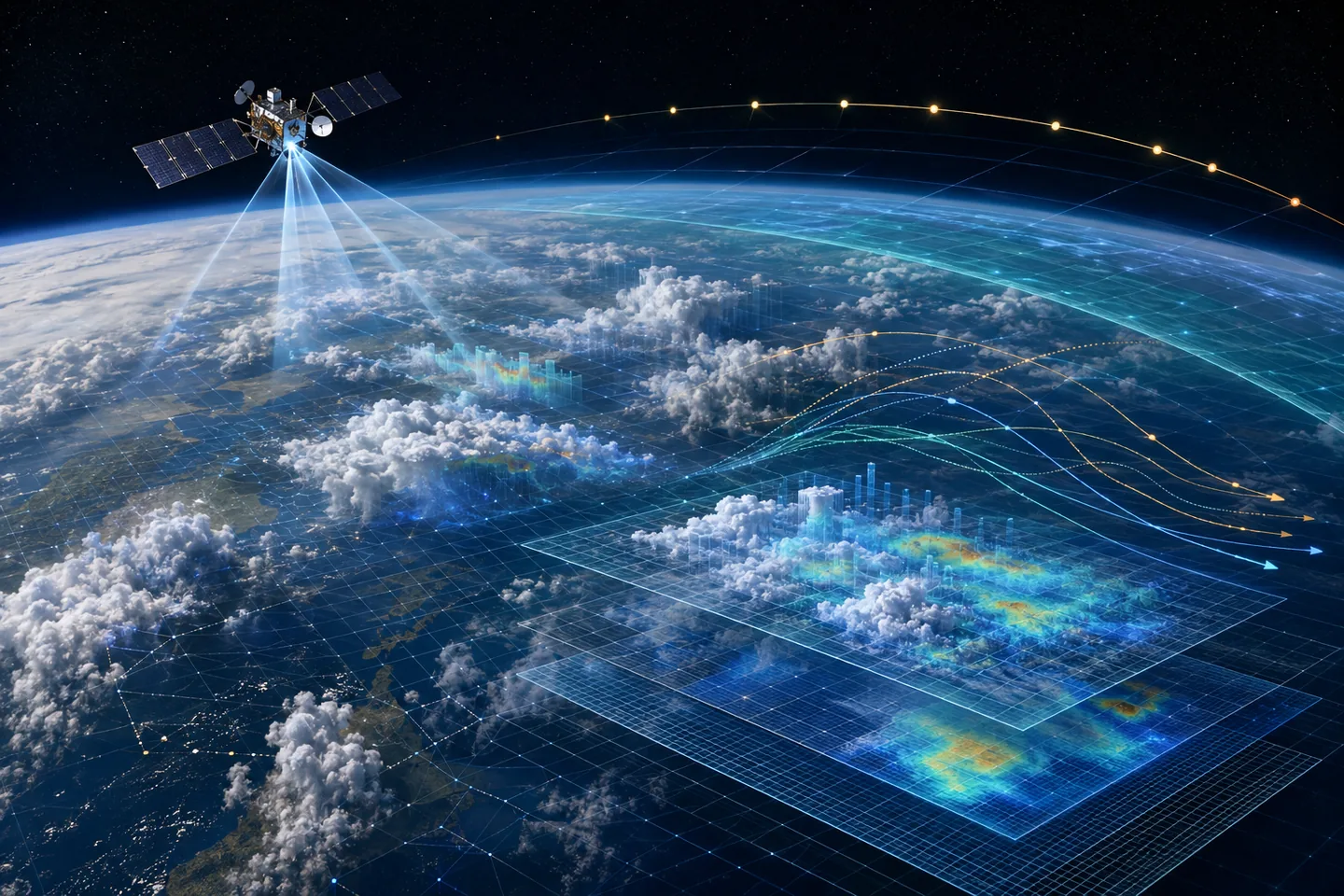
Google DeepMind and Google Research introduced WeatherNext 3 on 3 September, a global weather model that produces a new forecast every hour. It ingests current mosaics from geostationary satellites and weather-station observations. Its outputs are beginning to feed Google Search, the Gemini app, Maps, Google Maps Platform and Earth Engine, while forecast data are also available through cloud services.
The model offers a grid of roughly five kilometres for surface temperature and dew point, ten kilometres for other surface variables, and 25 kilometres for some atmospheric fields. WeatherNext 2 used a 25-kilometre global grid and six-hour steps. A five-times finer grid for selected variables does not by itself mean a five-times more accurate local forecast; input quality, lead time and the type of event also matter.
For medium-range probabilistic precipitation forecasts, Google reports CRPS improvements of up to 60% against NASA IMERG observations, 30% against the US MRMS radar dataset and 10% against rain gauges at early lead times. For consumer products, it claims up to 50% more accurate precipitation forecasts when planning a day or more ahead. The phrase up to matters: these are maxima in particular comparisons, not a guaranteed gain everywhere.
Brightband's live Operational WeatherBench places WeatherNext 3 among the leading global systems under operational evaluation, reducing the opportunity to select only favourable historical episodes. Longer observation across extremes, sensor outages and regions is still needed. The model also adds turbine-height wind, cloud and solar-radiation fields for energy applications, but Google explicitly says official warnings should come from national meteorological services.



Be the first to open the discussion.