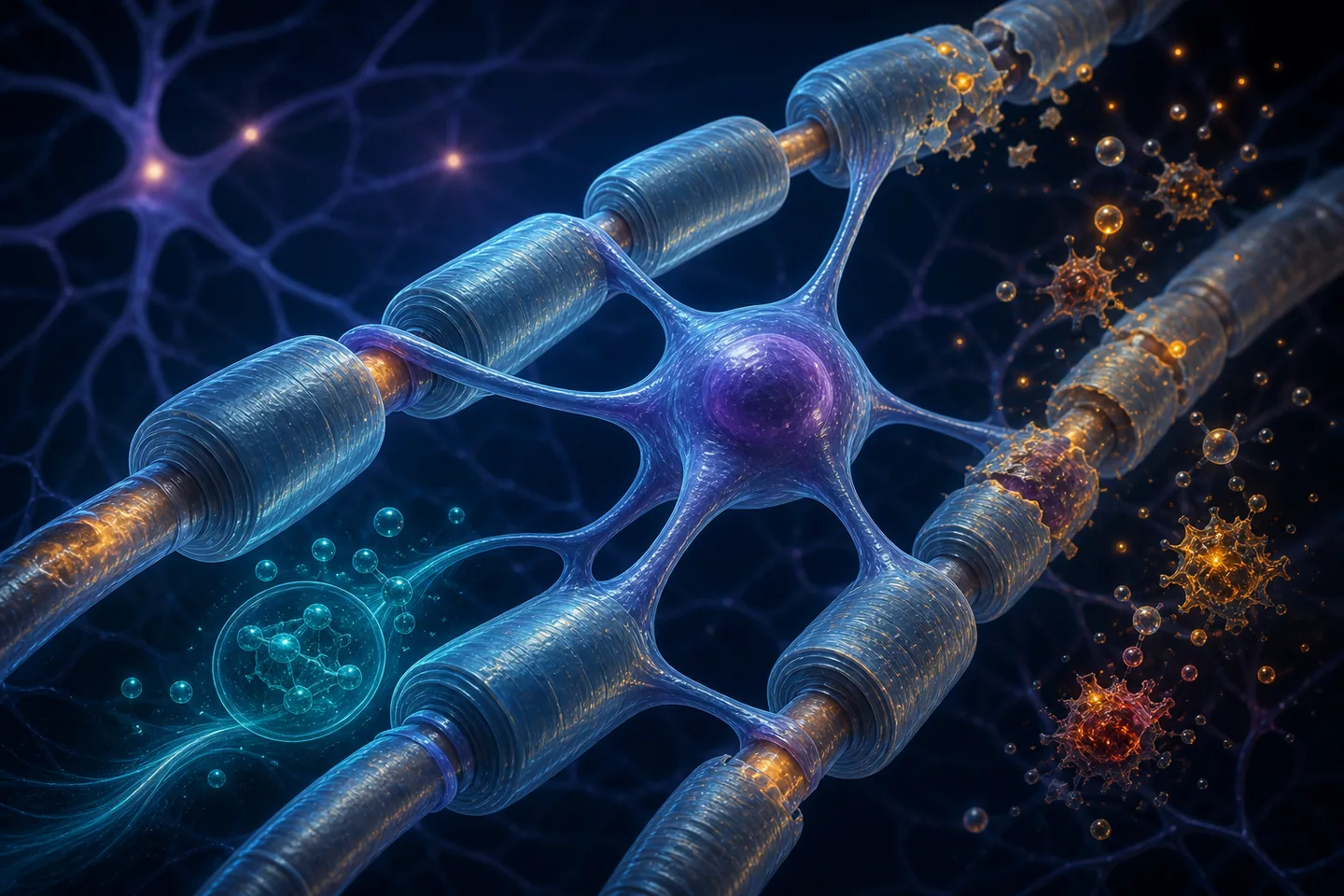
Oligodendrocytes make myelin, the insulating sheath that helps signals travel rapidly along nerve fibres. The authors followed cognition in members of the Lothian Birth Cohort 1936 from roughly age 70 to 82. Of 1,017 people with childhood and age-70 scores, 866 had later measurements. Poorer trajectories were associated with subtle changes in myelinated axons and oligodendrocytes in post-mortem tissue.
The tissue analyses were far smaller: depending on the method they included 13–21 brains, while single-nucleus RNA sequencing used 14 samples. Researchers found smaller myelinated axons, relatively thicker myelin around large axons, more oligodendrocytes and reduced NRF2 protective signalling in some subtypes. Thicker myelin therefore cannot simply be read as healthier; it may reflect disturbed maintenance or compensation.
A more causal test came from aged mice in which NRF2 was deleted specifically in oligodendrocytes. The animals reproduced part of the pathology and gained less cognitive benefit from an otherwise supportive environment. This strengthens the biological hypothesis, but it does not show that activating NRF2 will halt human cognitive decline or that existing NRF2-related products are an appropriate treatment.
If confirmed, the mechanism could support biomarkers of myelin and oligodendrocyte health, help distinguish ordinary ageing from Alzheimer’s or vascular disease, and eventually inspire cell-targeted ways to preserve neural connections. A practical route might combine imaging, blood or cerebrospinal-fluid markers and interventions that adjust protective pathways only in the cells that need them.
Translation requires replication in more diverse cohorts and other brain regions, a non-invasive biomarker, and a safe way to modulate NRF2 selectively. Optimistically, stronger validation and biomarker studies could emerge within 3–5 years. If the human mechanism holds, first small targeted intervention studies are conceivable in 7–12 years; routine treatment cannot yet be estimated honestly.


Be the first to open the discussion.