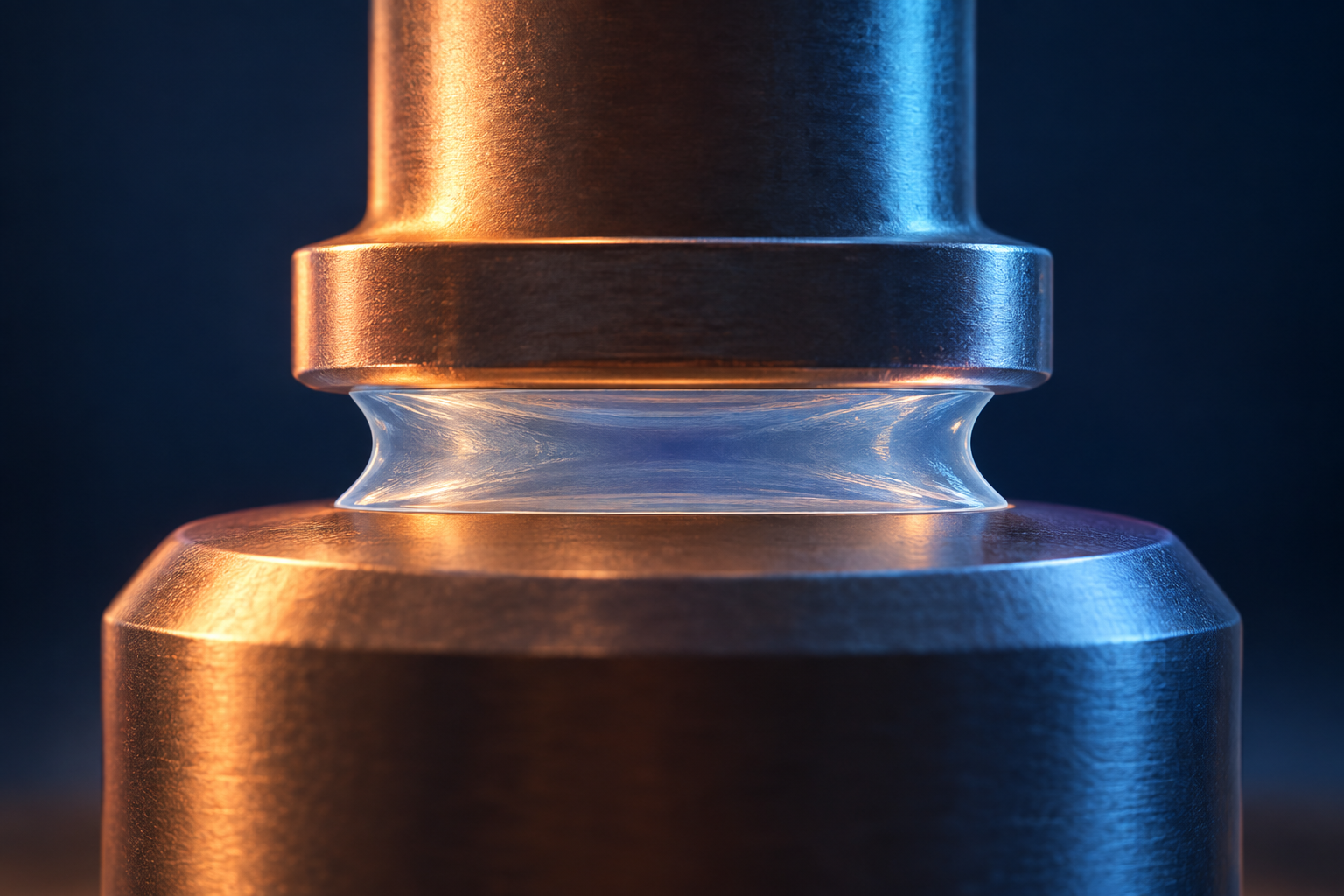
A computing element need not merely move information: it can briefly retain it through changes in its material. An MIT team demonstrated this principle using an approximately two-nanometre PDMS polymer layer between gold electrodes. Voltage compresses the layer, changing the tunnelling current. Recovery is not instantaneous, so the response retains a trace of earlier stimulation.
This material memory enabled the experiment to mimic accumulation of inputs and a pulse once a threshold is crossed, reproducing selected neuronal behaviour. It is neither a biological cell nor evidence of a functioning neural network. The authors measured energy consumption of 54 nJ in an active area of 200 × 200 nanometres. The much lower figure of around 2 fJ per pulse is a theoretical prospect requiring reduced losses and further development, not achieved operating consumption.
The authors also connected two elements so that activating one temporarily suppressed the other. This is a step towards a network, not a network trained for a useful task. The device retains memory on the order of seconds, so the result does not promise an immediate replacement for fast digital electronics.
If such elements could be reliably interconnected in larger numbers, they might eventually process slow temporal patterns beside a sensor. Imagine a detector that evaluates recurring changes in its input signal and sends an alert instead of continuously streaming data. This is a possible future use of the principle, not an application demonstrated in this study.
Practical progress requires independent replication, reduced leakage current, stable characteristics and endurance testing. Interconnects and control electronics must also be included in the energy budget: an advantageous individual element does not guarantee an efficient system. Manufacturing many consistent devices and combining them into a useful network remain further challenges.
Optimistically, small laboratory assemblies for simple sensing tasks might emerge in 2–5 years if these obstacles can be overcome. This is an editorial estimate, not the researchers’ timetable. There is no credible date yet for ordinary products or a replacement for today’s AI chips.
Be the first to open the discussion.