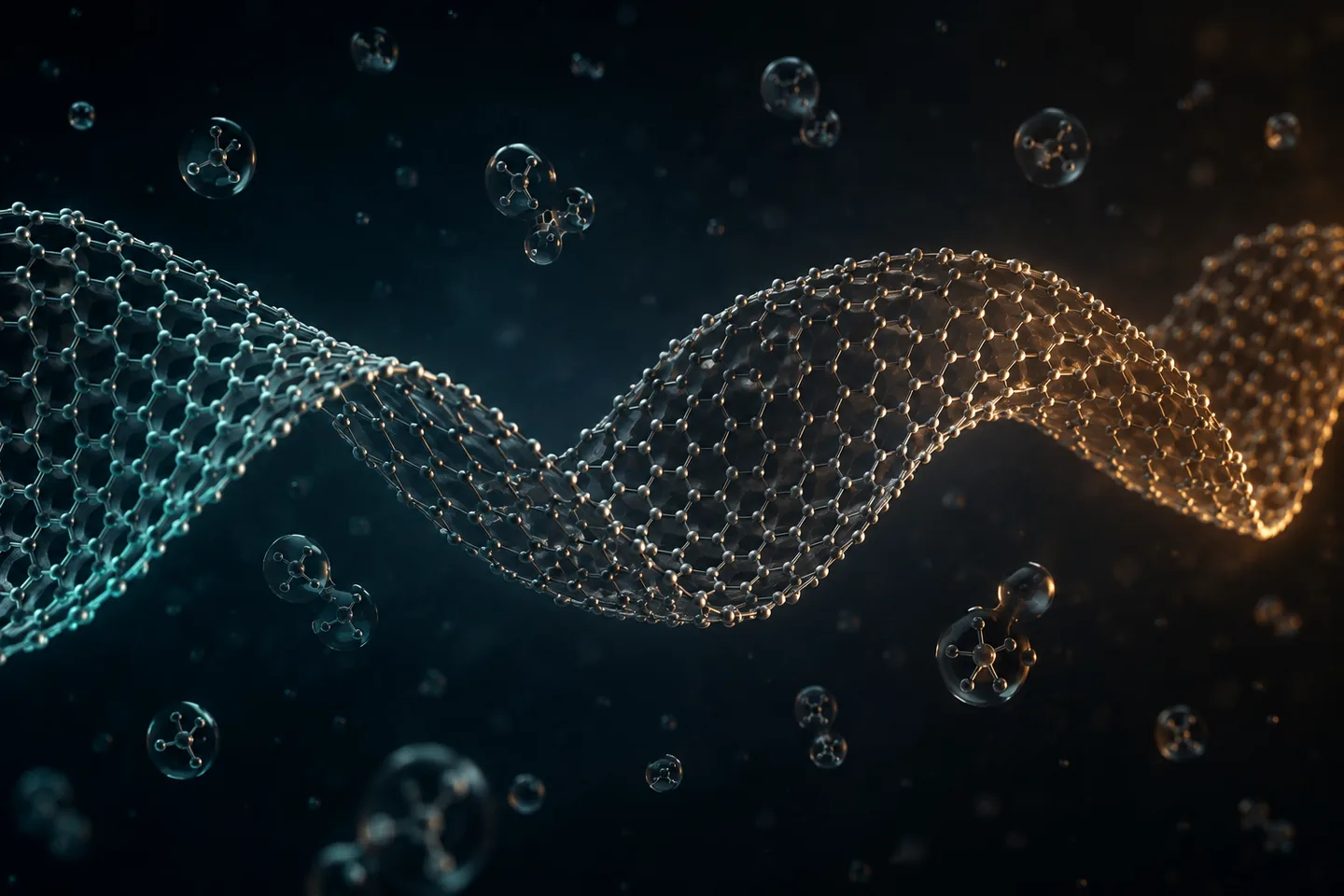
A Nagoya University team built a rigid carbon nanoribbon from connected [4]helicene units. Individual small units reverse their twist readily, but linking them into a long chain makes neighbours influence one another, aligning most of the ribbon into the same right- or left-handed configuration.
The direction can be selected with either mirror-image form of beta-pinene, a natural chiral compound found in plant oils. Changing the geometry also reverses the circular polarization of light emitted by the material. The authors describe it as the first graphene nanoribbon with solvent-controlled switching of both helicity and circularly polarized luminescence.
The result has important limits. This is neither an ordinary graphene sheet nor a finished memory component. Strong alignment occurred in a chiral solution and was greatest at −90 °C, weakening as temperature rose. Once the solvent is removed, the ribbon drifts back towards a mixture of unstable configurations and cannot yet retain the selected state.
If switching can be moved to room temperature and locked in place, related molecules could become optical switches, extremely small sensors for chiral or hazardous chemicals, or components that filter electrons by spin. The collective response is particularly attractive: a tiny molecular cue is amplified along the connected chain into a measurable change.
Practical use requires chiral memory, repeatable cycling without degradation, cheaper length-controlled synthesis and integration on solid substrates. Optimistically, laboratory sensors and optical demonstrators may appear in 3–6 years, with room-temperature components more likely in 7–12 years. Broad spintronic use would require longer validation of electrical performance and manufacturing.
Be the first to open the discussion.