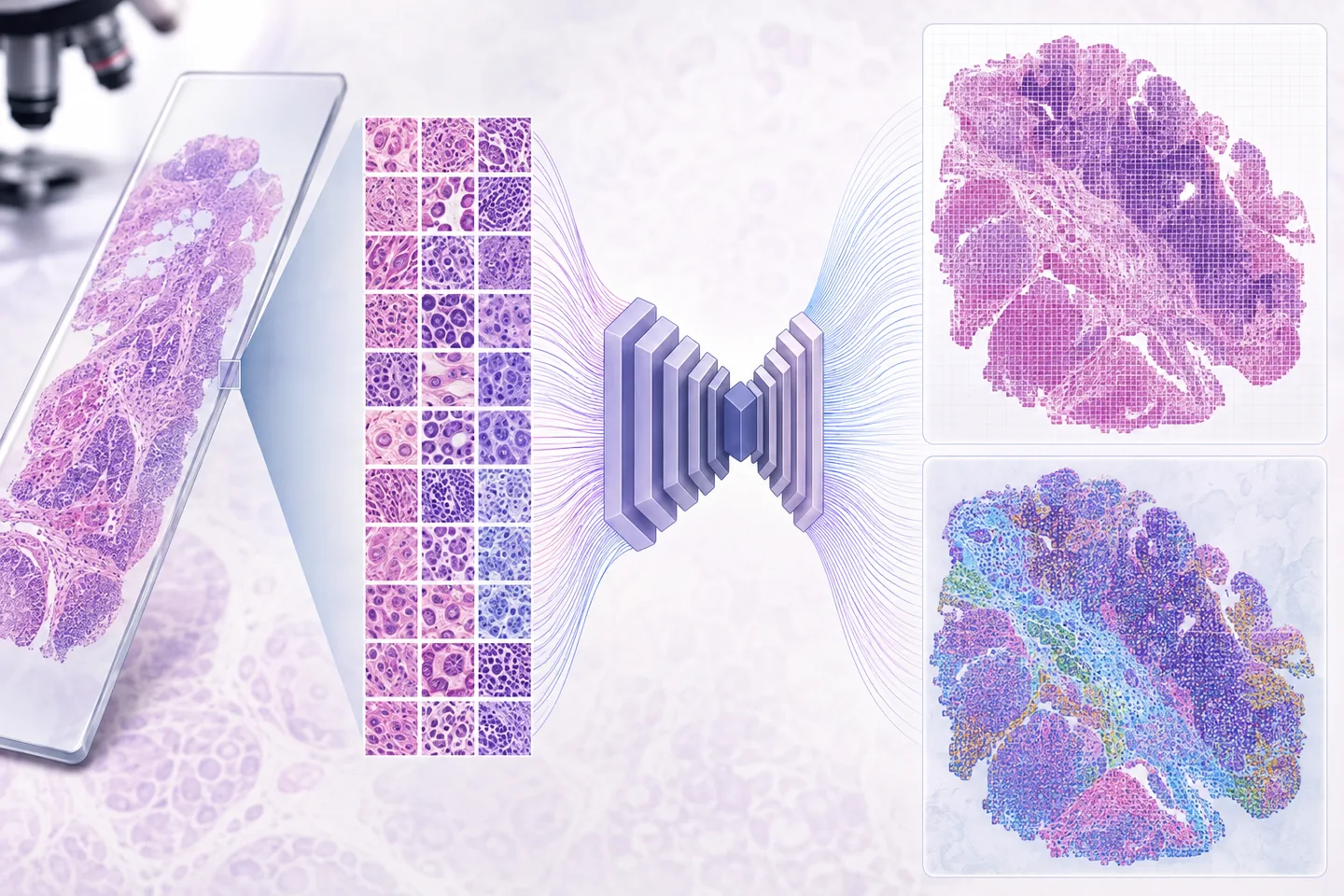
Microsoft Research released GigaPath‑Flash and GigaTIME‑Flash on 31 August, a pair of models for research on digitized pathology slides. Code and weights are available under the Apache 2.0 licence. Developed with the University of Washington and Providence, the project targets repeated analyses of large slide collections that are computationally expensive with the original large models.
GigaPath‑Flash uses a 22-million-parameter ViT‑S image encoder distilled from the roughly billion-parameter GigaPath, plus a 21-million-parameter LongNet for whole-slide context. On PANDA prostate grading and EBRAINS brain-tumour subtype classification, the authors report that it retained about 97% of the original model's average performance with roughly 50 times less compute. Two benchmarks do not cover every organ, scanner or laboratory.
GigaTIME‑Flash uses the same compact foundation to translate routine H&E staining into virtual spatial-proteomics maps. In tests spanning brain, breast, colon and lung cancers, it matched or improved on the original GigaTIME while running about six times faster and using eight times less GPU memory. Predicted protein maps are not physical measurements and still need laboratory confirmation for a specific hypothesis.
Lower requirements could make larger-cohort analysis, biomarker discovery and tumour-microenvironment research accessible to teams with more limited hardware. The authors explicitly describe an early research release that is neither intended nor validated for diagnosis, prognosis, treatment selection or other patient care. Clinical use would require independent validation across populations, institutions and devices.


Be the first to open the discussion.