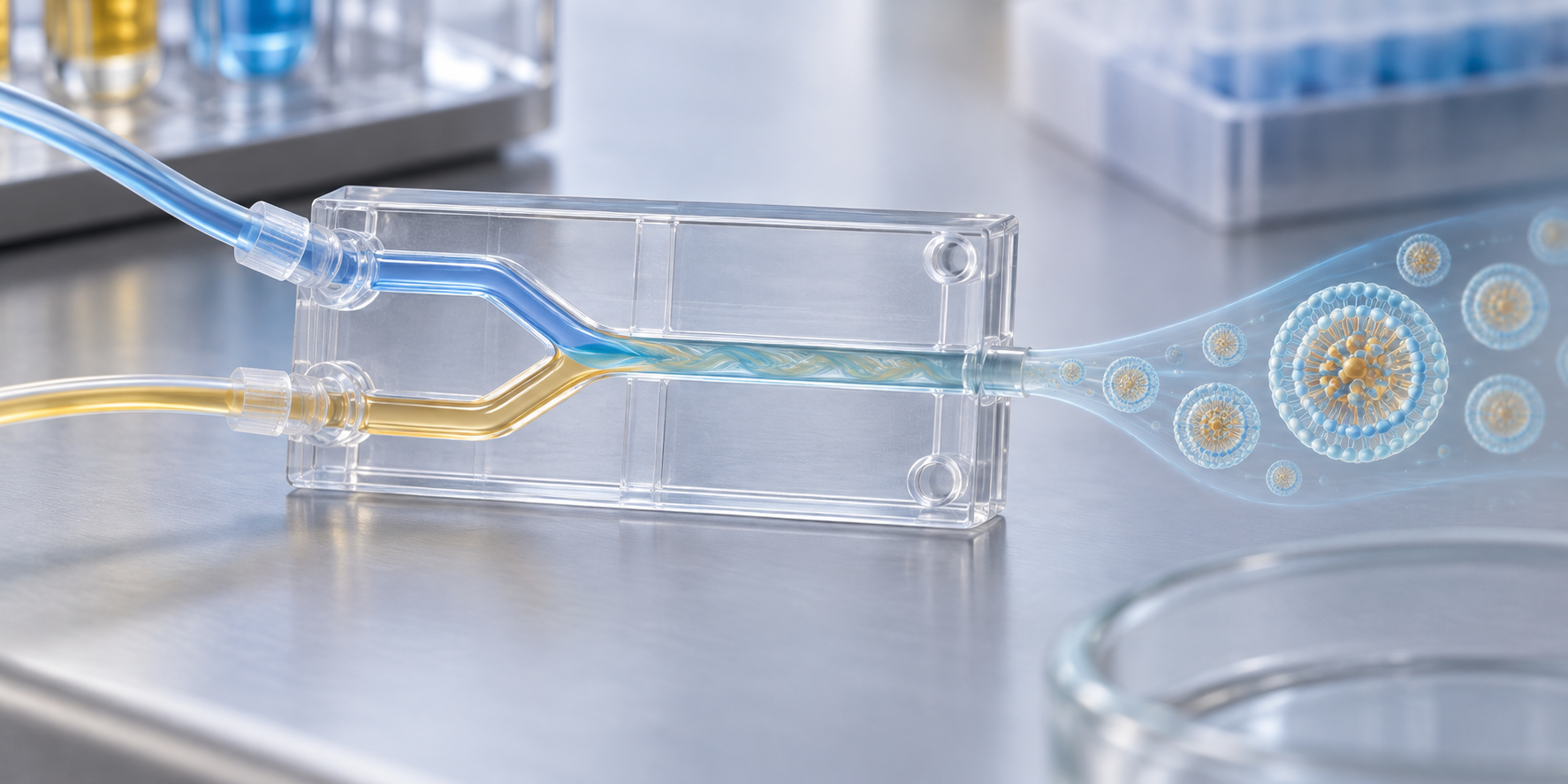
RNA breaks down readily in the body, so experimental medicines often package it inside lipid nanoparticles. Their properties depend not only on ingredients but also on how liquids flow and mix during manufacturing. In a peer-reviewed ACS Nano study, MIT researchers present a platform that tests and adjusts production conditions to reach a target particle size.
The system uses two-stage mixing and measures particle size during production through light scattering. When the result misses its target, it changes the settings for subsequent experiments. Automated trials also supply data for a model linking process settings to particle properties. Shape can be influenced too, but MIT says it is not yet measured within the automatic feedback loop and must be checked separately.
The potential benefit is faster comparison of carriers for RNA vaccines and other nucleic-acid therapies. Researchers might produce particles of different sizes with less manual tuning, then test what those particles actually do in cells and organisms. Precise manufacturing alone does not show that a carrier will reach the intended tissue, be safe or improve a treatment.
Practical use requires replication across different formulations, workable costs at larger scale, and evidence of biological delivery and safety. Any particular drug would still need preclinical and clinical testing. Optimistically, further research pilots might emerge within two to four years; this study cannot support a timetable for broad clinical use. Several authors are named on an MIT provisional patent application and the team is pursuing commercialization, a relevant context for its claims.

Be the first to open the discussion.